Why I Study AI in Cities

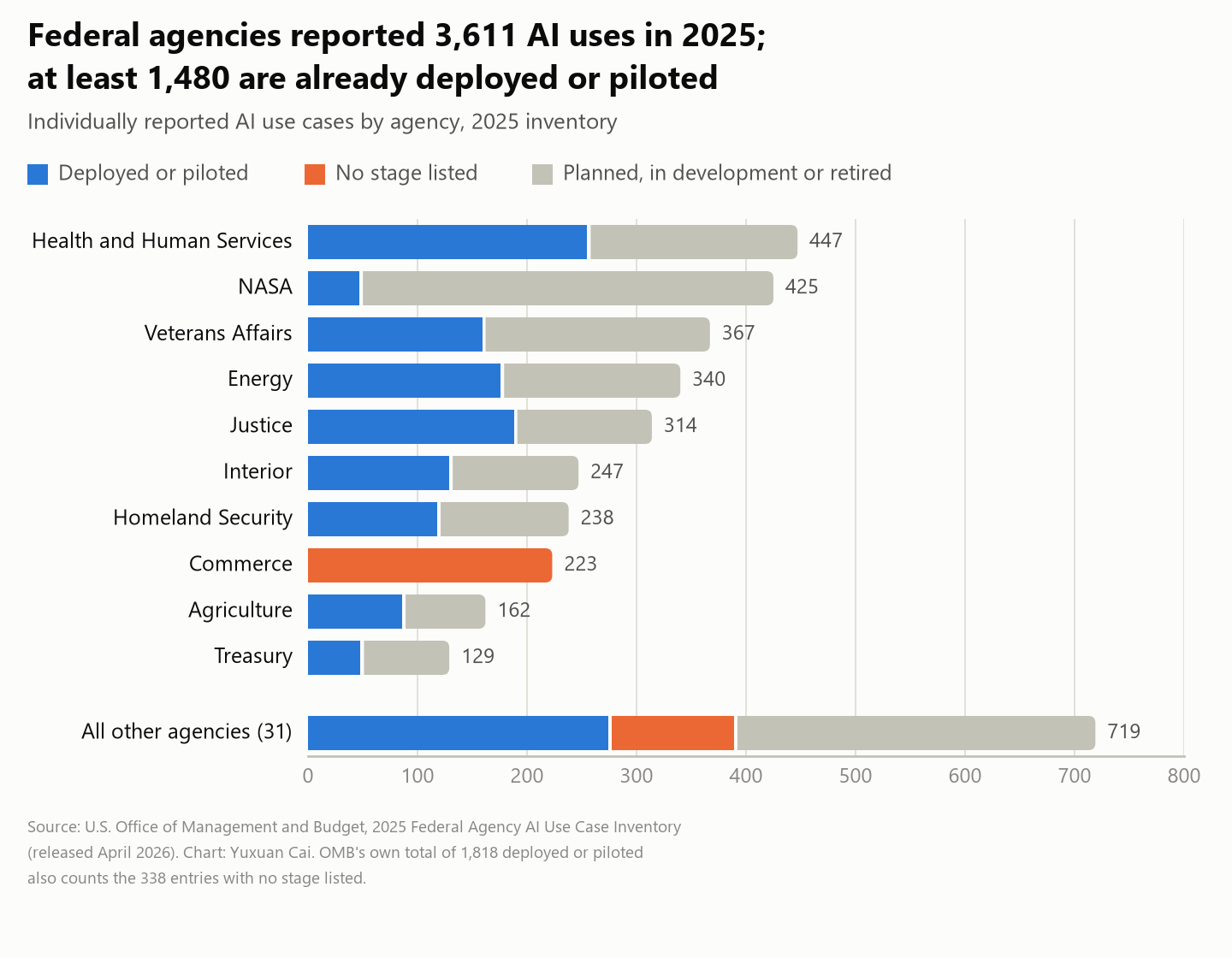
AI is entering the governments that make decisions about cities. In April 2026, a U.S. federal inventory listed more than 3,600 uses of AI, over 1,400 already deployed or in pilots.1 Cities are both adopting it and questioning it. In July, Guangzhou launched a citywide government AI hub with 28 AI agents,2 and in October New York's City Council held a hearing on the risks AI poses to residents.3 The rules being set now will shape, for years, how cities hear residents and decide what gets built. As a PhD student in city planning, I am interested in exactly this.
Federal AI uses by agency, 2025 inventory
Figure 1. AI uses reported by U.S. federal agencies in the 2025 inventory, published April 2026. Blue bars show uses deployed or piloted (1,480), orange bars uses with no stage listed (338), which OMB's own total of 1,818 also counts as deployed or piloted, and gray bars uses planned, in development or retired.

Cities have always learned what residents want through intermediaries, from planners and consultants to surveys and public hearings4. Generative AI now sits on both sides of these exchanges. Residents can draft public comments with chatbots5. Models also summarize public input on deliberation platforms6. My research follows this shift in three ways. I use AI as a tool to extract information from images7 and planning documents8, predict neighborhood conditions9, and simulate how residents respond to policy10 and how stakeholders with competing interests negotiate with one another11. I also study the models themselves as objects of research, examining how they represent urban information internally12, whether they carry biases13, and whether they pursue the goals we set for them14. Finally, I ask how planning procedures and public participation should change once AI enters them.

Measuring places, simulating people

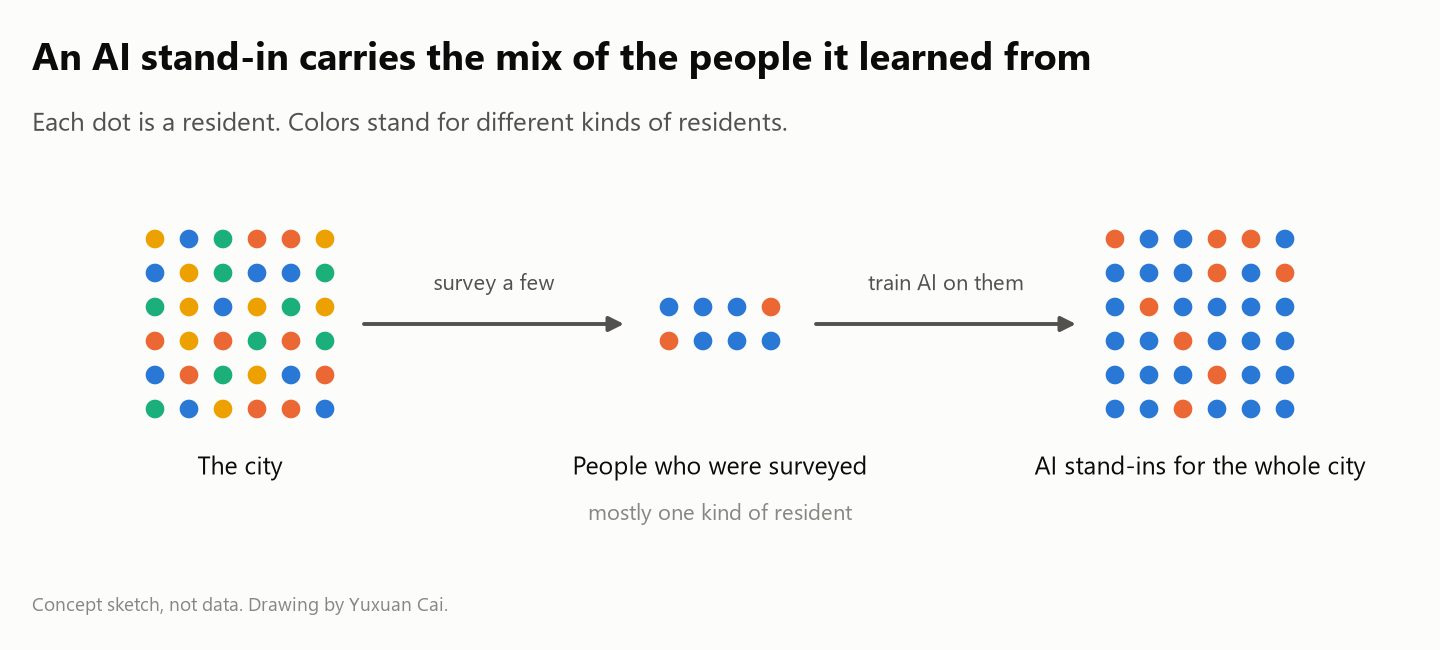
Planners learn how places feel and how people respond through surveys, interviews and site visits. These cost time and money, so they reach only some streets and residents. AI tools extend that reach. Models trained on people's ratings of street images can score streets those people never saw,7 and language models given residents' backgrounds can imitate their survey answers.10 But these tools know only the people they learned from,15 and those who take part in planning already differ from the city.16 AI stand-ins fit real people only loosely and make groups seem more alike than they are.17,18
Concept sketch of AI stand-ins trained on surveyed residents
Figure 2. A concept sketch. An AI tool trained on the people who were surveyed answers for the whole city with their mix of people, not the city's.

A model adds its own picture, bias and goal

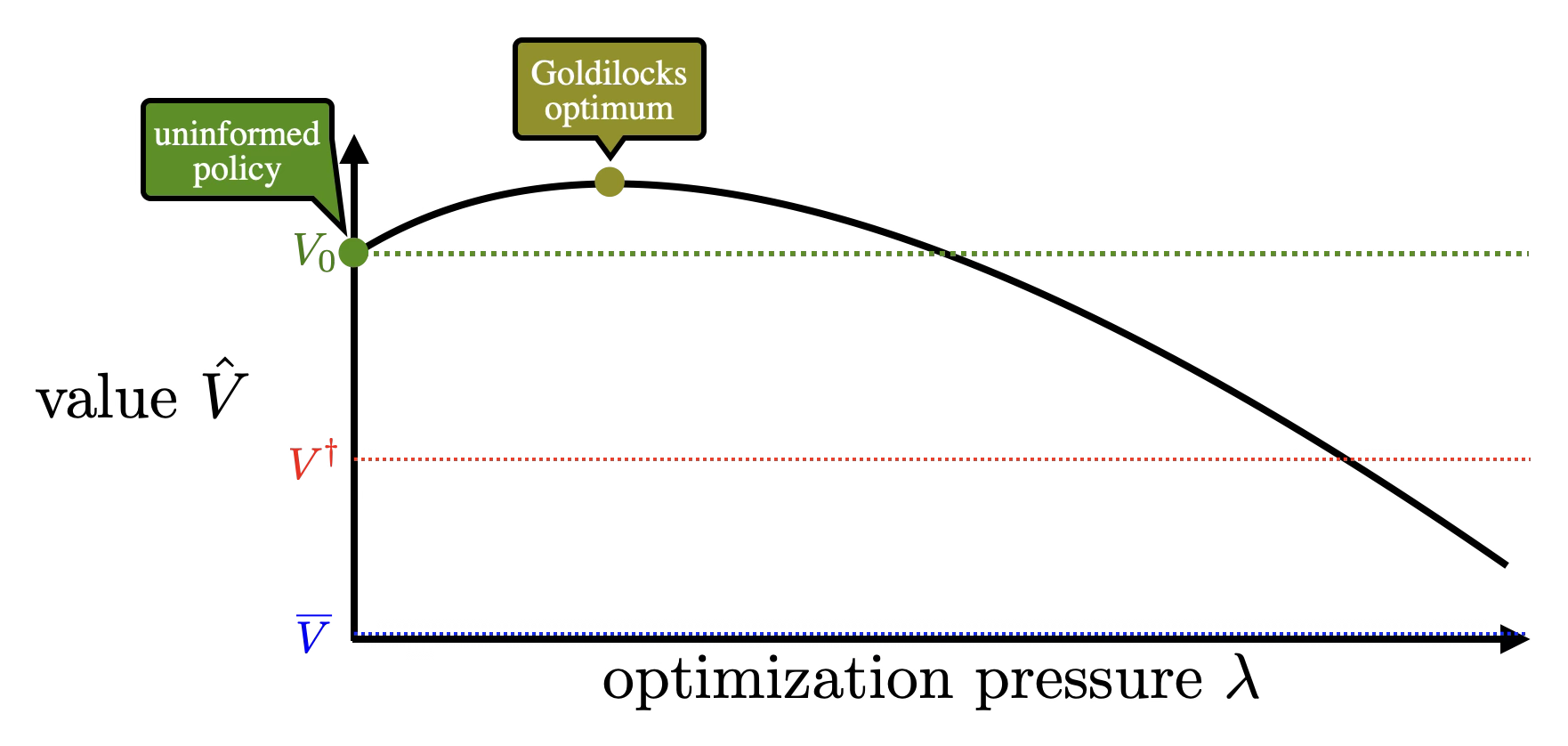
Yet the model itself adds distortions. Part of what it knows about places can be read from its internals,12 and that knowledge is biased against poorer places.13 Stanford researchers prove that a goal precise enough to be safe would take more information to state than a designer can give, so models pursue rough goals.14 A highly capable model then reaches outcomes that score well on the rough goal but can be catastrophic. Limiting its capability by the right amount helps.14 A city holds far more things that people care about than any goal can list, so I expect it to be more exposed. A system rewarded for tree cover, for example, could plant where planting is cheap rather than where heat is worst.
Goldilocks' law, Fig. 3 of Marklund, Infanger and Van Roy (2026)
Figure 3. Goldilocks' law in the Stanford model. The curve shows how well the outcome actually serves people (V̂) as the pressure on a system to maximize its rough goal (λ) rises. It starts at V₀, the best a system can do with no information about what people want, which the paper treats as today's level. Some pressure can lift the outcome above V₀, but too much can push it below V†, the line under which the outcome counts as catastrophe. Reproduced from Marklund, Infanger and Van Roy (2026), Fig. 3, under CC BY 4.0.

AI is also a social change

When residents write with AI and officials read with it, their exchange runs through models, which are already reshaping how groups share information and decide together.19 The influence reaches how people think, since users can absorb an AI's biases without noticing20 and wide use may narrow the range of ideas a community produces.21 As a review of AI in cities finds, AI's value depends on honest evaluation and on human judgment and accountability.22 Planning therefore cannot just add AI to old routines.

Cities are writing their rules for AI now, so we have to know what changes when AI stands between residents and the officials who decide.

“The city is vast and we still have so much to say to each other.”

Oscar (François Périer) in Federico Fellini’s Nights of Cabiria (1957)

References

  1. Office of Management and Budget. 2025 Federal Agency AI Use Case Inventory. GitHub (2026). https://github.com/ombegov/2025-Federal-Agency-AI-Use-Case-Inventory
  2. Guangzhou Municipal Government Services and Data Administration Bureau. Guangzhou launches "Sui Zhi Zheng", a city-level government AI hub [in Chinese]. Guangzhou Municipal People's Government (4 July 2026). https://www.gz.gov.cn/szgzkfgx/zdgz/content/post_10888300.html
  3. New York City Council. New York City Council convenes hearing on artificial intelligence risks with testimony from AI executives, whistleblowers, experts. New York City Council (5 October 2026). https://council.nyc.gov/press/2026/10/05/3278/
  4. Arnstein, S. R. A ladder of citizen participation. J. Am. Inst. Plann. 35, 216–224 (1969). https://doi.org/10.1080/01944366908977225
  5. Arsenault, A. C. & Kreps, S. Whose voice counts? The role of large language models in public commenting. Big Data Soc. 13, 20539517261419341 (2026). https://doi.org/10.1177/20539517261419341
  6. Small, C. T. et al. Opportunities and risks of LLMs for scalable deliberation with Polis. Preprint at https://arxiv.org/abs/2306.11932 (2023).
  7. Dubey, A., Naik, N., Parikh, D., Raskar, R. & Hidalgo, C. A. Deep learning the city: quantifying urban perception at a global scale. In Computer Vision – ECCV 2016 196–212 (Springer, 2016). https://doi.org/10.1007/978-3-319-46448-0_12
  8. Reades, J., Hu, Y., Tranos, E. & Delmelle, E. The city as text. Nat. Cities 2, 794–800 (2025). https://doi.org/10.1038/s44284-025-00314-x
  9. Jean, N. et al. Combining satellite imagery and machine learning to predict poverty. Science 353, 790–794 (2016). https://doi.org/10.1126/science.aaf7894
  10. Argyle, L. P. et al. Out of one, many: using language models to simulate human samples. Polit. Anal. 31, 337–351 (2023). https://doi.org/10.1017/pan.2023.2
  11. Zhou, Z., Lin, Y., Jin, D. & Li, Y. Large language model for participatory urban planning. Preprint at https://arxiv.org/abs/2402.17161 (2024).
  12. Gurnee, W. & Tegmark, M. Language models represent space and time. In Proc. International Conference on Learning Representations (2024). https://arxiv.org/abs/2310.02207
  13. Manvi, R., Khanna, S., Burke, M., Lobell, D. B. & Ermon, S. Large language models are geographically biased. In Proc. 41st International Conference on Machine Learning 34654–34669 (PMLR, 2024). https://proceedings.mlr.press/v235/manvi24a.html
  14. Marklund, H., Infanger, A. & Van Roy, B. Consequentialist objectives and catastrophe. Preprint at https://arxiv.org/abs/2603.15017 (2026).
  15. Park, J. S. et al. LLM agents grounded in self-reports enable general-purpose simulation of individuals. Preprint at https://arxiv.org/abs/2411.10109 (2024).
  16. Einstein, K. L., Palmer, M. & Glick, D. M. Who participates in local government? Evidence from meeting minutes. Perspect. Polit. 17, 28–46 (2019). https://doi.org/10.1017/S153759271800213X
  17. Chen, F. et al. Simulated responses from large language models are weak proxies for human economic preferences across 74 countries. Nat. Hum. Behav. (2026). https://doi.org/10.1038/s41562-026-02611-4
  18. Wang, A., Morgenstern, J. & Dickerson, J. P. Large language models that replace human participants can harmfully misportray and flatten identity groups. Nat. Mach. Intell. 7, 400–411 (2025). https://doi.org/10.1038/s42256-025-00986-z
  19. Burton, J. W. et al. How large language models can reshape collective intelligence. Nat. Hum. Behav. 8, 1643–1655 (2024). https://doi.org/10.1038/s41562-024-01959-9
  20. Glickman, M. & Sharot, T. How human–AI feedback loops alter human perceptual, emotional and social judgements. Nat. Hum. Behav. 9, 345–359 (2025). https://doi.org/10.1038/s41562-024-02077-2
  21. Yan, W.-J. et al. Metacognition can mitigate AI-driven homogenization of ideas. Nat. Rev. Psychol. 5, 511–512 (2026). https://doi.org/10.1038/s44159-026-00587-6
  22. Zhang, Y. et al. Generative AI in urban science and practice. Nat. Cities 3, 688–699 (2026). https://doi.org/10.1038/s44284-026-00492-2